
Every year, the same list gets recycled. TikTok. Snapchat. Instagram. BeReal. Discord. Locket. The names rotate slightly but the architecture stays the same: a feed, an algorithm, a follower count, and a design that treats your attention as the product.
This article is different. We are not ranking the most popular apps. We are asking a harder question: in 2026, after everything teens have been through with social media — the anxiety, the comparison, the permanence of things that should have disappeared — what does a social app actually look like when it is built from first principles for this generation?
The answer is more interesting than the list you have read before.
What Teens Actually Want in 2026 — The Data
Before looking at any app, understand what the research says about where this generation is heading.
According to Pew Research Center, nearly two-thirds of US teens have now tried AI tools like ChatGPT and many use them daily. A separate analysis found 55 percent of Gen Z have taken at least one social media detox in the past year to manage anxiety and digital fatigue. Hootsuite's 2026 data confirms that the vast majority of Gen Z actively want to spend less time on their devices — placing more value on content that feels meaningful rather than addictive.
The pattern is unmistakable. This generation does not hate technology. They hate technology that performs for strangers, stores everything forever, and makes them feel worse about themselves. They are moving away from the broadcast-to-everyone, infinite-scroll, algorithm-curated experience and toward something more private, more immediate, and more real.
Gen Z is not leaving social media. They are leaving social media that was designed for someone else.
Every app worth discussing in 2026 needs to be evaluated against that shift. Here is the honest landscape.
The Apps Everyone Is Talking About
Locket Widget — The Private Feed
Locket puts a live photo from a best friend directly onto the iPhone home screen. No feed to scroll. No algorithm. Just a friend's face from five minutes ago. It is genuinely wholesome — contacts-only, no public audience, no stranger danger. The limitation: it is a widget, not a social experience. It shows you what one person is doing right now. It does not create urgency, creativity, or a reason to send something back.
BeReal — The Authenticity Experiment
BeReal asked a genuinely interesting question: what if you could only post once a day, at a random moment, with a two-minute window? The answer was a brief cultural moment that peaked in 2022-2023 and has been declining since. The mechanic — spontaneous dual-camera capture — was novel but not behaviorally sticky. There were no stakes. Nothing disappeared. Nobody had to respond. The urgency was fake because nothing was lost if you missed it.
Discord — The Digital Basement
Discord remains the dominant space for teen community, particularly around gaming and interest groups. It is powerful precisely because it is not a social media app in the traditional sense — it is infrastructure for private communities. No algorithm, no public feed, no follower counts. The limitation for casual social use: it requires an existing community to join. It does not solve the problem of sending something to a specific person with stakes attached.
Character.ai — The AI Bestie
The rise of Character.ai is the most significant teen behavior shift of 2025-2026. Teens are spending hours talking to AI personas. For a generation that grew up anxious about social judgment, talking to an AI feels safer than talking to a human. This is not a social app — it is a companionship app. It tells you something important about what teens are missing from human social experiences: the feeling of being heard without being judged.
Snapchat — The Original, Still Running
Snapchat invented ephemeral social content and built a generation of users on it. In 2026, it remains enormous but has drifted far from its original premise. Stories, Spotlight, Snap Map, Snap AI, Games, Subscriptions — Snapchat is now a media company that happens to have a camera. The disappearing message mechanic still exists but is buried under layers of features that have nothing to do with intimacy or urgency. The clock starts when someone opens your snap — not when you send it. The stakes were always optional.
Snapchat invented the genre. It just stopped playing it.
LOCKSY: The App That Is Doing Something Nobody Else Has Done
Every app above shares one foundational assumption: the social experience begins when the recipient engages with the content. You send something. They open it whenever. The clock, if there is one at all, starts when they look at it.
Locksy made a different assumption. What if the clock started the moment you hit send?
Not when they open the notification. Not when they tap the message. The moment it is sent. Both sides racing the same clock in real time from that exact second — whether or not the recipient has even opened the app.
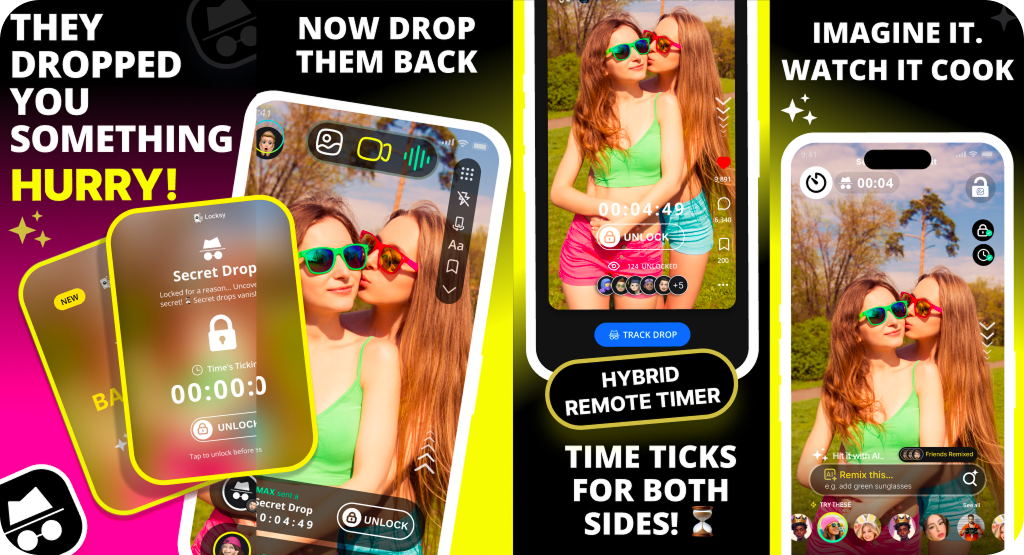
This is Locksy's proprietary dual-sided countdown — the Hybrid Remote Timer. It is the only mechanic in any social app where time runs simultaneously for sender and recipient from the moment of send. We go deeper on this mechanic in The App That Killed the Streak. Miss the window and the content is permanently deleted — from Locksy's servers and from both devices. No recovery. No replay. No second chance.
The clock starts when you send. Not when they open it. That single decision changes everything.
What this creates is something no other social mechanic has ever produced: a genuinely live, shared event between two people triggered by the act of sending. Both sides present. Both sides racing. The message matters before it is even opened. We wrote about that feeling firsthand in Inside the Locksy Experience.
The Smart Camera — The Other Thing Nobody Else Has Built
Every social app ever made treats the camera as a starting point you leave behind. A notification arrives — you leave the camera. You want to send a voice note — you leave the camera. A message comes in — you leave the camera to reply.
Locksy's Smart Camera was built on a completely different architectural principle: the camera should never stop. We unpacked this decision in The Social Camera Has Been Broken for 10 Years. We Fixed It.
Photos, videos, voice notes, text messages, chats, notifications, and incoming Drops — all of it happens on the live camera view without ever interrupting it. Single-tap switching between all four media types. Messages surface as overlays. The camera is always live. Nothing takes you away from the moment you are trying to capture.
This required treating AVFoundation as the master layer of the entire app rather than a feature within it. Every notification system, every media type, every social interaction in Locksy is designed to exist on top of the camera — not instead of it. That is an architectural decision. You cannot retrofit it onto an existing social app. It requires building from first principles.
No other social camera on the market works this way. Not one.
Locksy AI Remix — Where AI Actually Belongs in Social
Most social apps added AI the same way they added every other feature: as a room next door. An AI tab. A filter menu. A separate creative tool you navigate to and away from.
Locksy AI Remix has no room next door. It lives inside the Drop itself, as we detailed in Locksy's Native AI Layer Is Coming.
Teens type a free-text prompt — anything they can imagine — and watch their photo transform in seconds before sending. No presets. No ready-made looks. No ceiling on what they can ask for. Just type it and watch it happen. Then lock it, send it, and the countdown starts for both sides before the recipient even knows it exists.
The transformation happens fast — approximately 5 to 7 times faster than comparable AI image tools — because it has to. The countdown is already running. An AI tool that takes 10 to 15 seconds cannot exist inside an experience built around urgency. Locksy AI Remix was engineered specifically to keep pace with the mechanic it serves.
Traditional lenses and filters show you a preset. Locksy AI Remix executes whatever you imagine. That is not an upgrade. That is a different category.
The result is an experience that no other social app currently offers: AI transformation that is fast enough to use inside a countdown, creative enough to produce something genuinely worth sending, and ephemeral enough that the result disappears before it can be overthought.
Why Locksy Is Different From Every App on This List
Every other app on this list solves one problem. Locket solves presence. BeReal solves authenticity. Discord solves community. Character.ai solves companionship. Snapchat solved ephemerality — then drifted away from it.
Locksy solves four problems simultaneously inside a single flow:
The creative problem — AI Remix means every Drop can be something genuinely impressive, not just a camera snapshot.
The urgency problem — the Hybrid Remote Timer means every Drop creates real stakes from the moment of send.
The camera problem — the Smart Camera means the creative experience never stops, never fragments, never interrupts the moment.
The permanence problem — everything vanishes. Not optionally, not eventually. Everything. We explored the philosophy behind this in The Last Generation to Grow Up on Feeds.
And crucially — none of these four things compete with each other. They all live inside the same Drop flow. Capture, remix, lock, send, countdown. One screen. One gesture. Under ten seconds. This is the same architectural achievement we broke down in One Screen. Four Superpowers.
Four problems. One flow. Zero friction. That is what it means to build from first principles.
Who Locksy Is For
Locksy is built for US teens aged 13 to 18. It is available exclusively in the United States on the iOS App Store. It is free to download and always will be.
It is built for the teen who is tired of performing for an audience. Who wants a social experience that feels like a real moment between real people — urgent, creative, private, and gone before it can be second-guessed.
There is no public feed. No follower counts. No algorithm surfacing random content. Backroom is invitation-only — your real circle pulls you in. Everything disappears. Locksy does not sell user data, does not run ads, and has no advertising relationships. Ever. As we explained in Locksy Is Not Competing With Social Media — this is a different premise entirely, not a better version of the old one.
The optional Golden Lock subscription at $6.99 per month unlocks unlimited Drops, full AI Remix access, screenshot protection, and a Golden Lock verification badge. The core experience is free. Always.
The Honest Verdict on 2026 Teen Social Apps
The apps teens are using in 2026 tell a coherent story: they want less, not more. Less public, less permanent, less performative. More private, more urgent, more real.
Locket gets the privacy right but not the stakes. BeReal got the authenticity right but not the retention. Discord gets the community right but not the intimacy. Character.ai gets the safety right but replaces human connection instead of improving it. Snapchat got the ephemerality right a decade ago and then walked away from it.
Locksy is the only app in 2026 that starts from the right question — what does a social experience feel like when it is built entirely around urgency, creativity, privacy, and impermanence as its foundational architecture rather than its afterthought — and builds everything from that answer.
The countdown starts the moment you send. That is not a feature.
That is a philosophy.
Locksy is available exclusively in the United States on the iOS App Store. Free always. Download Locksy on the App Store to see the difference for yourself.
 Drop the Mystery!